


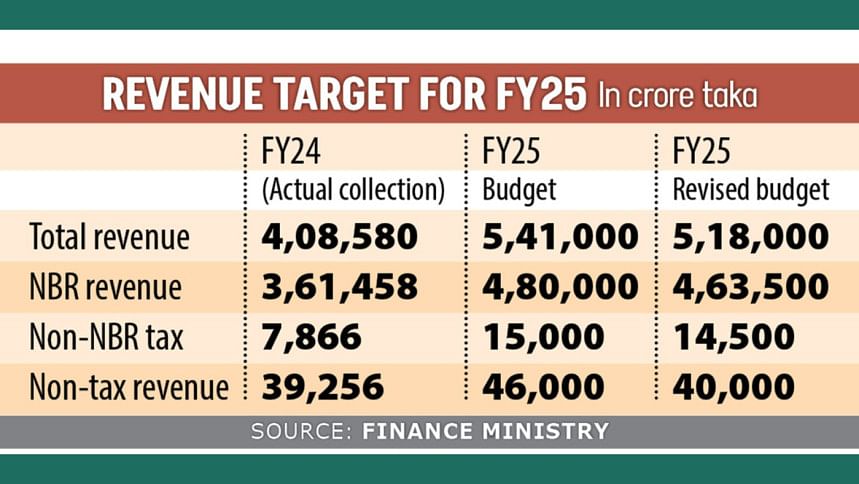

The government of Bangladesh has set an ambitious revenue collection target for fiscal year 2024-25 in its revised budget, with a focus on boosting domestic resource mobilization. The revenue target for FY25 is set at Tk 5,18,000 crore, which aligns with the floor set by the International Monetary Fund (IMF) as part of its $4.7 billion loan program. This revised target represents a 26% increase from last year’s revenue collection.
In comparison, the original revenue target for this fiscal year was Tk 5,41,000 crore. The National Board of Revenue (NBR) has been tasked with collecting Tk 4,63,500 crore of the total target. However, this will require the NBR to boost its collections by nearly 28% compared to the previous fiscal year. Despite this, NBR’s revenue collection has fallen by 0.98% in the first six months of the fiscal year, raising concerns about meeting the target.
The government’s ambitious goal is partly driven by the demands of three major multilateral development partners: the World Bank, the IMF, and the Asian Development Bank. These lenders have set higher revenue collection as a condition for providing budget support, urging Bangladesh to increase its tax-to-GDP ratio by 0.5% this fiscal year.
In an effort to boost revenue, the government has introduced several measures, including mandatory online submission of income tax returns for government officials and certain taxpayers, the introduction of e-payment for VAT deposits over Tk 10 lakh, and a reduction in tax exemptions. Additionally, the government has imposed a 15% VAT on a range of goods and services and launched an online platform for electronic tax deduction at source.
Despite these efforts, challenges persist. High inflation, a contractionary monetary policy, austerity measures in the financial sector, and slow implementation of the annual development program have led to doubts about whether the NBR will meet its target. As a result, the NBR has requested a further reduction of the revenue target in the revised budget.
Nasiruddin Ahmed, a member of the finance ministry’s advisory committee on NBR reform, warned that achieving the target could be difficult given the current macroeconomic conditions. He emphasized the link between revenue collection and economic growth, stating that tax revenue tends to increase when businesses grow and imports rise. However, he also pointed out significant gaps in the automation of tax collection and inadequate updates to existing laws, which hinder the NBR’s efficiency.
The IMF and other development partners are pressing for comprehensive reforms, including separating VAT policy from its administration, reducing tax exemptions, and enhancing automation in tax collection. The IMF has specifically called for reducing corporate income tax exemptions, raising VAT rates on certain products, and introducing additional income tax brackets for high earners.
The government has taken steps to raise VAT rates to 15% on nearly 100 goods and services, though it has reversed some of these increases in response to criticism. Ahmed criticized the ad hoc approach to VAT rate changes, highlighting the need for a more strategic and consistent policy.
As Bangladesh works to meet its revenue targets, the success of the revised budget will depend on the effective implementation of fiscal measures and the broader economic environment. While the government remains hopeful, experts caution that significant reform and improved tax administration will be crucial for long-term success.