


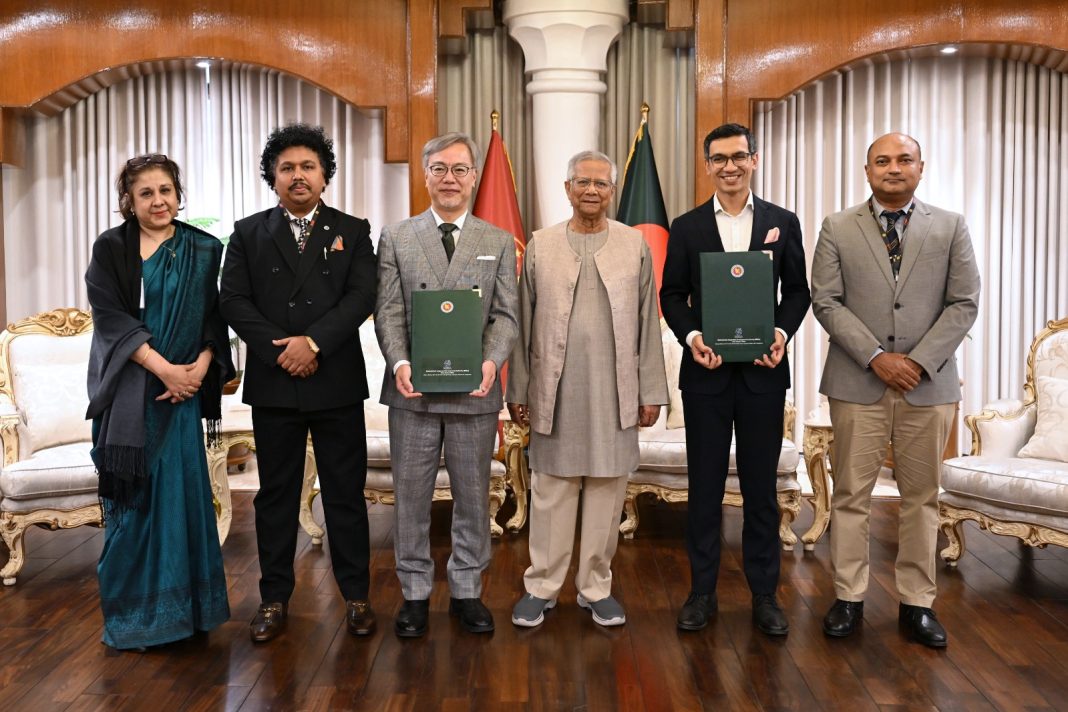
 has signed a landmark Memorandum of Understanding (MoU) with Japan’s world-renowned Sasakawa Peace Foundation (SPF) to advance the sustainable development of Bangladesh’s blue economy and marine resources. The agreement was signed on Wednesday afternoon at the State Guest House Jamuna in the presence of Chief Adviser Professor Muhammad Yunus.)
The Maheshkhali Integrated Development Authority (MIDA) has signed a landmark Memorandum of Understanding (MoU) with Japan’s world-renowned Sasakawa Peace Foundation (SPF) to advance the sustainable development of Bangladesh’s blue economy and marine resources. The agreement was signed on Wednesday afternoon at the State Guest House Jamuna in the presence of Chief Adviser Professor Muhammad Yunus.
This strategic partnership aims to transform three villages in Maheshkhali into model fishing communities by adopting Japan’s innovative “Umigyo” model—a comprehensive approach to marine industry-based community development. The MoU was executed by MIDA Executive Chairman Chowdhury Ashik Mahmud bin Harun and SPF’s Ocean Policy Research Institute (OPRI) President Professor Mitsutaku Makino.
During the ceremony, Professor Muhammad Yunus expressed grave concern over escalating marine pollution, noting that plastic waste has been detected thousands of meters below the sea surface. He emphasized that this collaboration is vital not only for the economic utilization of marine assets but also for restoring the ecological health of the Bay of Bengal. “Our ocean is a major asset, yet it is increasingly polluted. This partnership will help us protect and keep our seas clean,” the Nobel Laureate stated.
Under the terms of the agreement, Japan will provide technical expertise in mariculture, deep-sea fishing, and modern post-harvest management. The project includes plans for automated fish landing centers, cold-chain logistics, and advanced communication systems to ensure the safety of fishers at sea. To ensure a science-based approach, the Marine Science Institute of Chittagong University will be directly involved in the research initiatives, which are expected to expand over time.
MIDA Executive Chairman Ashik Chowdhury underscored the long-term vision of the partnership, stating that the objective is to build new economic frontiers while preserving traditional coastal livelihoods. He noted that the Bay of Bengal is the world’s largest bay, and Bangladesh must act decisively to unlock its untapped potential.
The Japanese delegation hailed the initiative as a “new horizon” in Bangladesh-Japan relations. The MoU was signed on the sidelines of the “Northeast Indian Ocean Regional Dialogue on Sustainable Blue Economy,” currently being held at the Pan Pacific Sonargaon Hotel in Dhaka. This collaboration aligns with the national priorities of over 20 ministries and agencies in Bangladesh, positioning the country to tap into the high-value global seafood market while ensuring environmental resilience.