


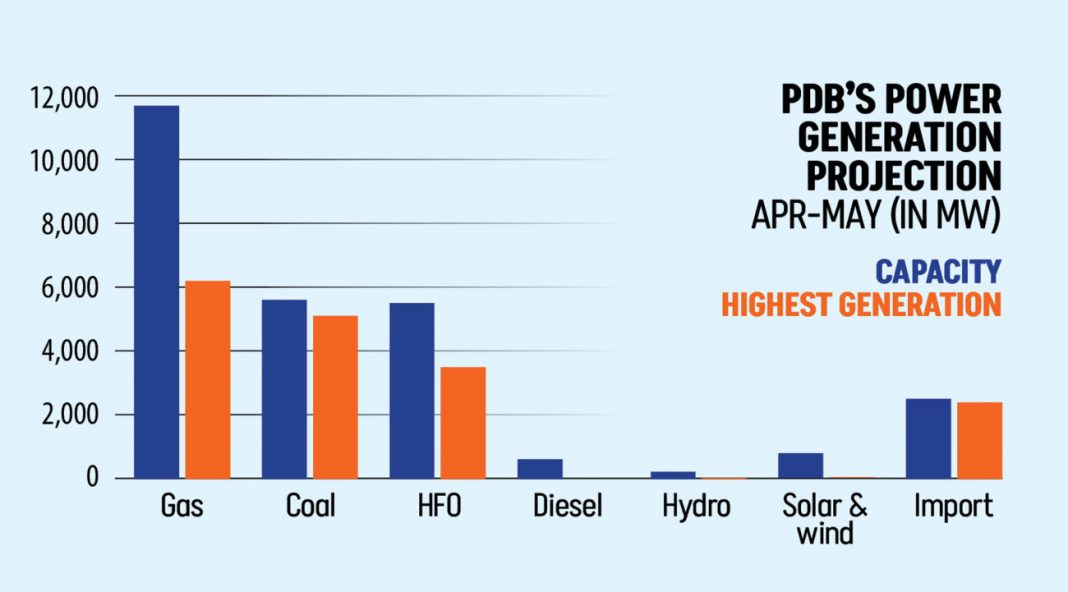

Desk Report: The Bangladesh Power Development Board (PDB) has projected that peak electricity demand during the summer months will reach 18,000 megawatts (MW), while the highest production target is set at 17,260MW. This indicates a potential load shedding of at least 740MW. In comparison, in 2024, the highest demand was 17,800MW, with peak generation reaching 16,477MW.
The government is prioritizing uninterrupted power supply during Ramadan, with the highest demand expected to be 15,700MW.
“We are striving for zero load shedding during Ramadan and only minimal power cuts in the summer monsoon,” said Muhammad Fouzul Kabir Khan, adviser to the Ministry of Power, Energy, and Mineral Resources, at a briefing at Bidyut Bhaban following an inter-ministerial meeting.
While zero load shedding is the goal, technical issues in transmission or distribution could still cause power cuts. After Ramadan, load shedding could rise to 1,400MW.
To support summer power generation, gas supply to power plants will be increased to 1,200 million cubic feet per day (mmcfd), enabling the production of up to 6,200MW from gas-fired plants, which have a total capacity of 11,677MW.
LNG imports will also be ramped up, with at least four cargoes arriving each month, compared to the usual 2-3 cargoes.
With air conditioning consuming about 6,000MW of total summer power generation, the government aims to reduce the cooling load, which accounts for nearly one-third of total demand.
“We can’t tell people not to use air conditioners, but we can encourage them to set their AC temperature at 25-26 degrees instead of 18 degrees,” said Khan. Authorities plan to involve mosque Imams, business leaders, and shop owners in raising awareness. A reduction in cooling load could lower power demand by 2,000-3,000MW.
To maintain stable power supply, the PDB has requested $4 billion from the finance division, which has assured financial support.
“They are overburdened, as all ministries have sought funds. However, we have engaged with the finance division and banking sector to ensure power producers don’t halt supply due to financial constraints,” Khan stated. The finance division will prioritize funding for fertilizer, food, power, and energy sectors.
If power shortages escalate, the government may implement measures such as:
- Restricting irrigation pump use to 11:00 PM – 9:00 AM
- Bringing forward shopping center closing times
- Reducing excessive lighting
- Encouraging responsible power usage
The power purchase agreement for the Matarbari coal-fired power plant will be finalized soon. Electricity from this plant is expected to cost Tk 8.40 per unit, making it more affordable than existing plants like Payra, Rampal, and Adani.
“We will also set benchmark pricing for gas-fired power plants and initiate renegotiations to bring down tariffs. Our aim is to avoid arbitrary decisions,” Khan concluded.