



STAFF CORRESPONDENT
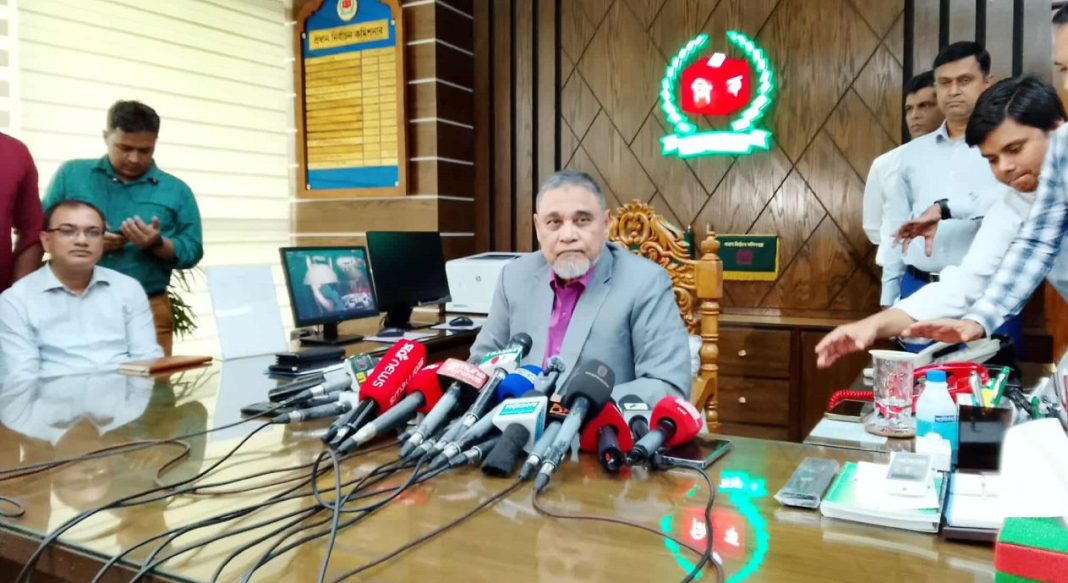
Chief Election Commissioner (CEC) AMM Nasir Uddin has said that regaining public trust and preventing the misuse of artificial intelligence (AI) will be the two biggest challenges in the upcoming national election.
He made the remarks on Wednesday, August 6, while speaking to reporters at the Election Commission (EC) Building in Agargaon, Dhaka.
He stated, “People have lost confidence in the Election Commission. We want to restore that trust. The media, political parties, and civil society must work together. The public should see that the election is fair, transparent, and festive. To this end, a massive awareness campaign will be launched.”
To address the risks of AI misuse in elections, the CEC said that the EC will prepare a strategic framework drawing on the experiences of developed countries.
“Fake information, doctored videos, and false propaganda have become major challenges,” he said. “Our aim is to prevent the misuse of AI.”
13th national election likely in February:
The Chief Election Commissioner also informed that, following the guidance of the Chief Adviser, preparations are underway to hold the 13th National Parliamentary Election in February next year. The election schedule will be announced two months in advance, he added.
“We are expecting to receive the official letter from the Chief Adviser soon. Once we have the letter, the Election Commission will finalize the schedule,” said the CEC.
Earlier, in a speech on the occasion of July’s Mass Uprising Day, Chief Adviser Muhammad Yunus indicated that the next general election would be held before Ramadan in February 2026. He also mentioned that a formal letter would be sent to the Election Commission in this regard.
The CEC further noted that the commission will keep one month in hand to consult various levels of stakeholders involved in the electoral process.
Delimitation and procurement update:
He emphasized that electoral boundaries will not be determined based on any individual but strictly in line with regulations. Instructions have already been given to election officials in this regard.
“The commission aims to complete election-related procurement by September 22,” he said. “Objections and claims will be accepted until August 10, and the final decision will be made after hearings.”
EC will ensure neutrality
Assuring neutrality in the conduct of the election, the CEC said that election officials and law enforcement agencies will be held strictly accountable to ensure impartiality.
“There’s no longer any political pressure like before. Instead, the pressure now is to perform professionally and impartially. Our goal is to ensure a level playing field. We’ve told the Deputy Commissioners, Superintendents of Police, administration, police, DGFI, and NSI to work without any partisan bias,” he said.
On the role of returning officers, he stated: “We are carefully reviewing their appointments. Measures are being taken to ensure that those who were previously biased act neutrally this time. There’s no pressure now—those who commit irregularities will be held accountable before the people, the state, and God.”
Awami League zupporters can vote
Regarding the Awami League’s registration status, the CEC said, “The registration issue is currently under judicial review. While the party may not be able to participate as an entity, individuals can still contest as independent candidates, and supporters can cast their votes. The Election Commission will take necessary steps in accordance with the law.”
He added, “Our main goal is to ensure a participatory election. Political parties and voters alike must be able to take part without any hindrance. Many parties have participated in past elections, and this time, we want even greater public involvement.”