


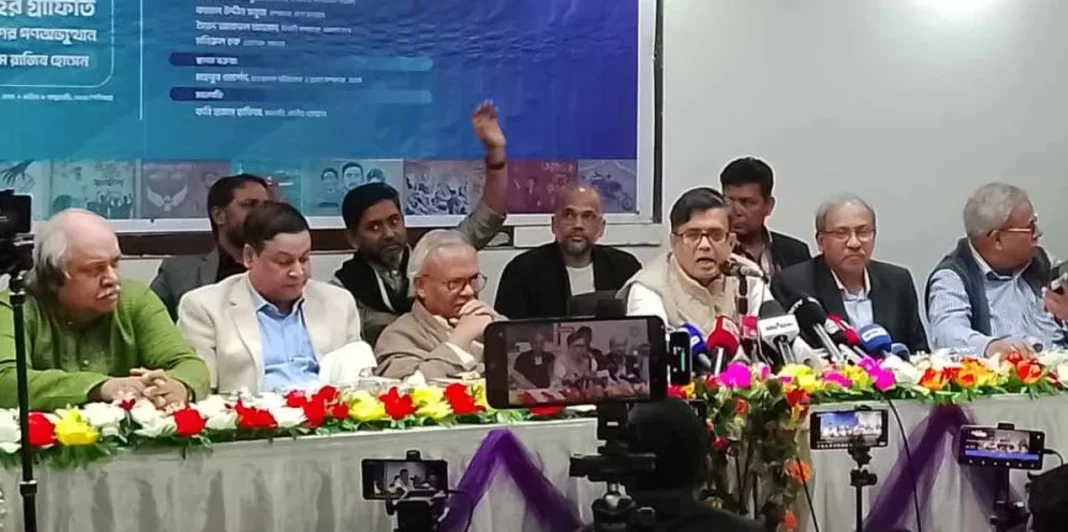

Desk report: BNP Senior Joint Secretary General Ruhul Kabir Rizvi has stated that while his party will continue to criticize various aspects of the interim government, they will not allow the administration led by Chief Adviser Dr. Muhammad Yunus to fail.
Speaking as the chief guest at a book launch event at the Zahur Hossain Chowdhury Auditorium of the National Press Club on Saturday, Rizvi made these remarks. The event was organized to mark the publication of GM Rajib Hossain’s book Droher Graffiti: Chobbisher Gono Abhuthan and was presided over by National Press Club President, poet Hasan Hafiz. Several prominent figures, including Shafiqul Alam, Press Secretary to the Chief Adviser; Kader Gani Chowdhury, Secretary General of the United Professionals Council; Syed Abdal Ahmad, Executive Editor of Amar Desh newspaper; and Kazi Raunak Hossain, Editor of Sargam magazine, attended as special guests.
During his speech, Rizvi accused India of directly interfering in Bangladesh’s sovereignty. He stated that while India’s decision to provide shelter to Sheikh Hasina was one matter, allowing her the freedom to instigate instability in Bangladesh was another. Rizvi argued that India was backing the reaction to Sheikh Hasina’s statements in Bangladesh, calling such interference a violation of international law.
Shafiqul Alam, speaking at the event, criticized the former Awami League government, alleging that they imposed their version of history on the people as a fascist tactic. He claimed that they attempted to portray Dr. Muhammad Yunus, a globally respected figure, as a terrorist while presenting themselves as victims. He further alleged that Sheikh Hasina and her associates had transferred $234 billion out of the country and were responsible for the enforced disappearance of 3,500 people. He also pointed to the killing of 2,000 people between July and August, including children as young as four, and mentioned incidents such as the Shapla massacre and the forced expulsion of the Chief Justice as examples of authoritarian rule.
Kader Gani Chowdhury emphasized the significance of the recent uprisings, stating that the sacrifices made by students and citizens in July and August had paved the way for freedom. He stressed the need to uphold this unity at any cost.
Syed Abdal Ahmad highlighted the importance of establishing a stable government through elections. He argued that law enforcement agencies were not fulfilling their responsibilities and warned that continued instability could lead to the return of an authoritarian regime.
The event underscored growing political concerns regarding governance, sovereignty, and the future trajectory of Bangladesh’s leadership.